
I Put AI Inside String Telephones and Made Them Play the Telephone Game

TechVisuals
2025/06/05What I Made
I placed a tiny AI (built from scratch) inside each cup of string telephones linked together in a chain,
creating a work in which words are altered and passed along, like in the telephone game.
How It Started
With the recent AI boom, we have been doing more and more creative work and development with AI at our company.
Amid all that, I applied with a proposal, together with our team member Sheena, to SICF, an art exhibition held in Aoyama every year during Golden Week. Both of our proposals were accepted, so I created this as a media art piece.
Concept
A string telephone is a toy that carries a voice over a distance: a string runs between two paper cups, and you speak into the cup at one end.
In this work, a tiny AI is placed inside each cup of string telephones linked together in a chain. Starting from words picked up from the real internet, the cups relay the words like a game of telephone. When a cup receives a voice, its built-in AI adds its own interpretation, creates a new message, and sends it on to the next cup.
A brainless AI with only 520 kB of memory, which I nonetheless choose to call "people."
Technical Details
Parts
- Microcontroller × 9
- Audio amplifier module × 9
- Small OLED display × 9
- Small speaker × 9
- Universal PCB × 9
- Wire × 3
- Mobile battery × 9
- Cup × 9
- 3D printed
What Is the ESP32?
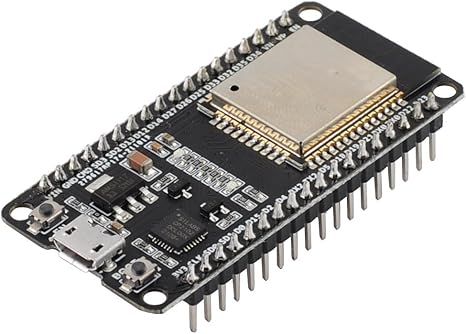
Each cup contains an ESP32, a small, inexpensive microcontroller (around 2,000–3,000 yen).
About the Homemade AI
The Challenge
The key question was how to meet one requirement of the concept: "the AI inside each cup changes the words it receives."
LLMs (large language models) like ChatGPT are being developed everywhere these days, so I looked for a small model that could run on a microcontroller like the ESP32 I used. But especially for Japanese, the required specs were far too large, so I gave up on direct "words → words" conversion. (Maybe in another two years or so it will become possible.)
In fact, since the ESP32 can communicate over a network, it would be possible to do the "words → words" conversion in the cloud and have the device only play audio and show text on the display.
But then the cups themselves wouldn't be doing any computation, which would make the concept a lie. So I designed a setup in which each cup (ESP32) replaces the words itself.
Turning "Words" into "Vectors"
Since running an LLM on an ESP32 is difficult, I implemented a way to convert words into vectors and rephrase them through vector arithmetic.
"Converting words into vectors" may sound difficult, but it's actually easy to understand with an everyday example.
For example, when you introduce a friend, you describe them by their traits: "tall, kind, and funny."
Vectorization works the same way: it represents the meaning of a word with multiple numbers.
Specifically, the word "apple" might be represented by a combination of numbers such as "fruitiness: 5, redness: 4, sweetness: 3, roundness: 2" (this combination is a vector).
Words with similar meanings (e.g., "apple" and "orange") end up with similar numbers, while words with completely different meanings (e.g., "apple" and "car") end up with very different numbers.
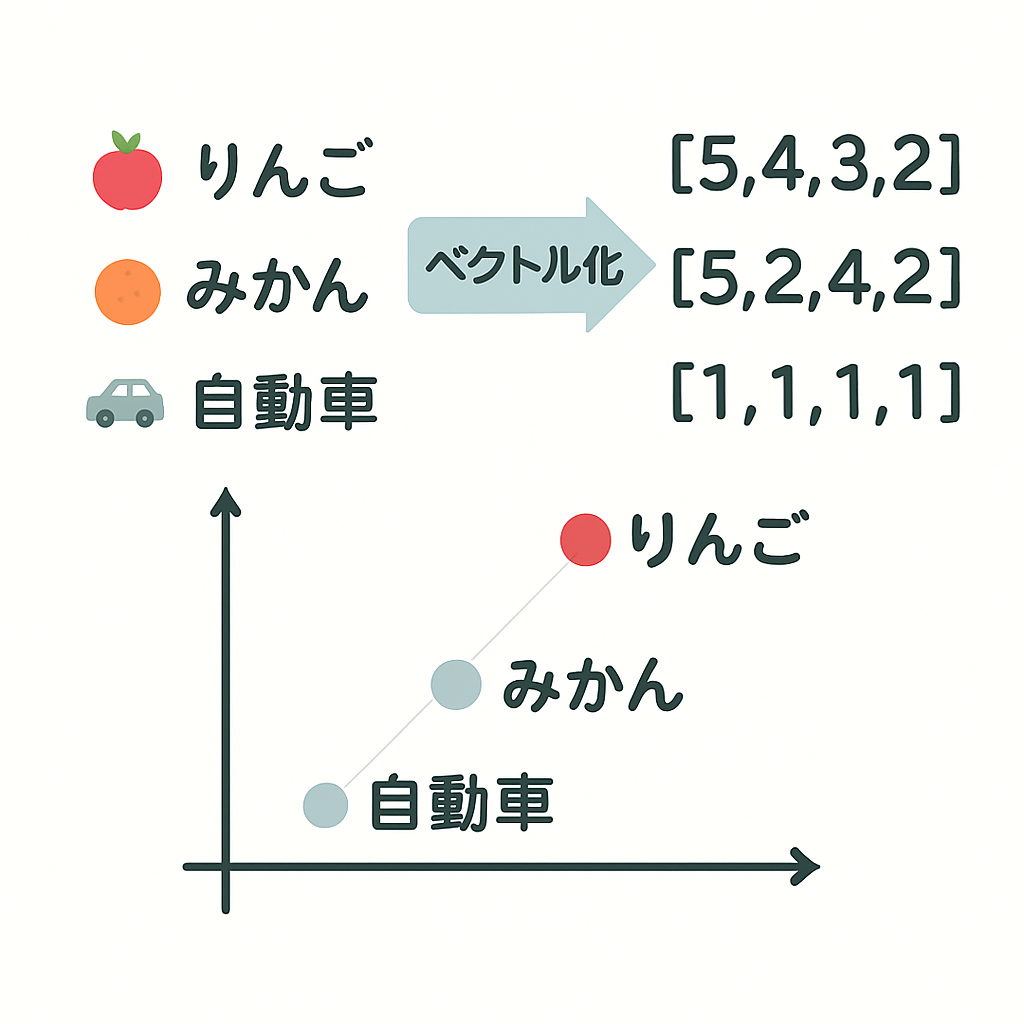
(Diagram made with AI: Manus/ChatGPT)
In this way, through numerical calculations, a computer can understand the meaning of words the way humans do and make judgments like "these two words are similar" or "this word means something completely different."
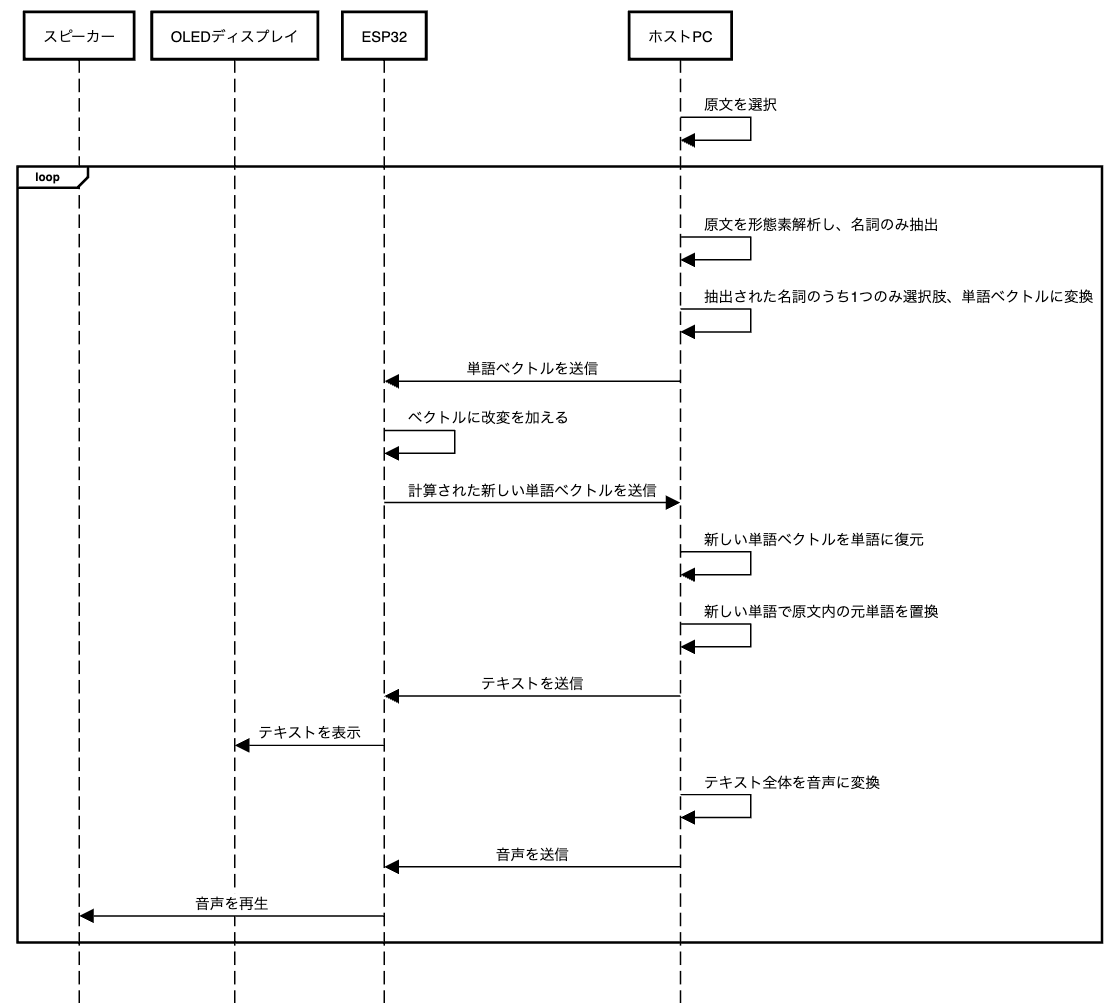
Concretely, this work transforms sentences through the following steps (simplified).
- Split the sentence into words (e.g., "私はパンを食べます" ("I eat bread") → "私" "は" "パン" "を" "食べます")
- Extract only the nouns (e.g., "私" "は" "パン" "を" "食べます" → "私" "パン")
- Select only the first noun (e.g., "私" "パン" → "私")
- Convert the selected word into a vector (e.g., "私" → [2.3, 1.4, 3.13, 5.46...])
- Add a random vector to it (e.g., [2.3, 1.4, 3.13, 5.46...] + 1.0 → [3.3, 2.4, 4.13, 6.46...])
- Convert the resulting vector back into a word (e.g., [3.3, 2.4, 4.13, 6.46...] → "俺," a more casual word for "I")
- Replace the original word "私" in the sentence with the converted word "俺" (e.g., "私はパンを食べます" → "俺はパンを食べます")
Sequence
Source Code
All the source code I wrote for this work is available on GitHub.